
Disordered Eating During Menopause:
Why Midlife Can Trigger an Unhealthy Relationship with Food (And What You Can Do About It)
For many women, menopause arrives with far more than hot flushes and disrupted sleep.
It can quietly change the way we think about food, our bodies and ourselves.
Perhaps you've found yourself constantly thinking about food.
Maybe you've started another diet because your clothes no longer fit the way they used to.
Perhaps you feel frustrated that the things which "used to work" no longer seem to make any difference.
Or maybe you're finding yourself caught between restricting food during the day and eating emotionally in the evening.
If any of this sounds familiar, you are not alone.
As both a Solution Focused Clinical Hypnotherapist specialising in eating disorders and disordered eating—and as a woman who has experienced many of these challenges personally—I understand how confusing and upsetting this stage of life can feel.
The good news?
It isn't a lack of willpower.
There are very real biological, psychological and hormonal reasons why menopause can affect your relationship with food.
Understanding those changes is often the first step towards finding peace again.

Why Does Menopause Affect Eating Behaviour?
During perimenopause and menopause, levels of oestrogen and progesterone fluctuate significantly before eventually declining.
These hormonal changes influence far more than our reproductive system.
They affect:
appetite regulation
blood glucose stability
mood
sleep
stress resilience
metabolism
fat distribution
cognitive function
energy levels
At the same time, cortisol—the body's primary stress hormone—often remains elevated, particularly if you're juggling work, caring responsibilities, ageing parents or teenagers, poor sleep and the emotional demands of everyday life.
Your brain and body are working much harder than they were ten or twenty years ago.
It's hardly surprising that food suddenly feels different.

One of the greatest myths surrounding menopause is that weight gain is simply caused by eating more and exercising less.
The reality is far more complex.
Research suggests that women lose approximately 3–8% of muscle mass per decade after the age of 30, with this accelerating during menopause if strength training and adequate protein intake are not maintained.
As muscle naturally decreases:
resting metabolic rate falls
insulin sensitivity changes
fat is more likely to be stored around the abdomen
energy levels decline
At the same time, sleep disruption and chronic stress increase cortisol, which can further influence appetite, cravings and fat storage.
This is biology—not failure.
Why Dieting Often Makes Things Worse
Many women respond to these body changes in the only way they've ever been taught.
They eat less.
Skip meals.
Count calories.
Cut carbohydrates.
Exercise harder.
Unfortunately, this often creates the very cycle they're trying to escape.
When the brain senses restriction, it doesn't think:
"I'm going on a diet."
It thinks:
"There may not be enough food."
The primitive brain responds exactly as it has evolved to do.
It increases hunger.
Food becomes more rewarding.
Cravings become stronger.
The mind becomes increasingly preoccupied with eating.
Research from studies of dietary restriction consistently shows that prolonged restriction increases food preoccupation, reduces metabolic rate and often results in rebound eating or binge episodes.
This is survival biology—not a lack of discipline.

The Hidden Link Between Menopause, Anxiety and Emotional Eating
Many women tell me:
"I know what I should eat… I just can't seem to stop."
Usually, the problem isn't knowledge.
It's stress.
When we're exhausted, anxious or overwhelmed, our primitive brain seeks comfort, certainty and quick sources of energy.
Highly palatable foods temporarily activate the brain's reward pathways, offering short-term relief.
But because the underlying stress remains, the cycle soon begins again.
Stress...
Restriction...
Cravings...
Emotional eating...
Guilt...
Another diet...
The cycle repeats.

Body Image During Menopause
Perhaps one of the hardest parts of menopause isn't the physical change.
It's grieving the body you once had.
Society places enormous value on youth, thinness and appearance.
Women are constantly told they should "bounce back", "reverse ageing" or "lose the menopause belly."
But your body is not failing.
It is adapting.
Learning to work with your body instead of constantly fighting against it can be one of the greatest gifts of midlife.
Finding Peace With Food During Menopause
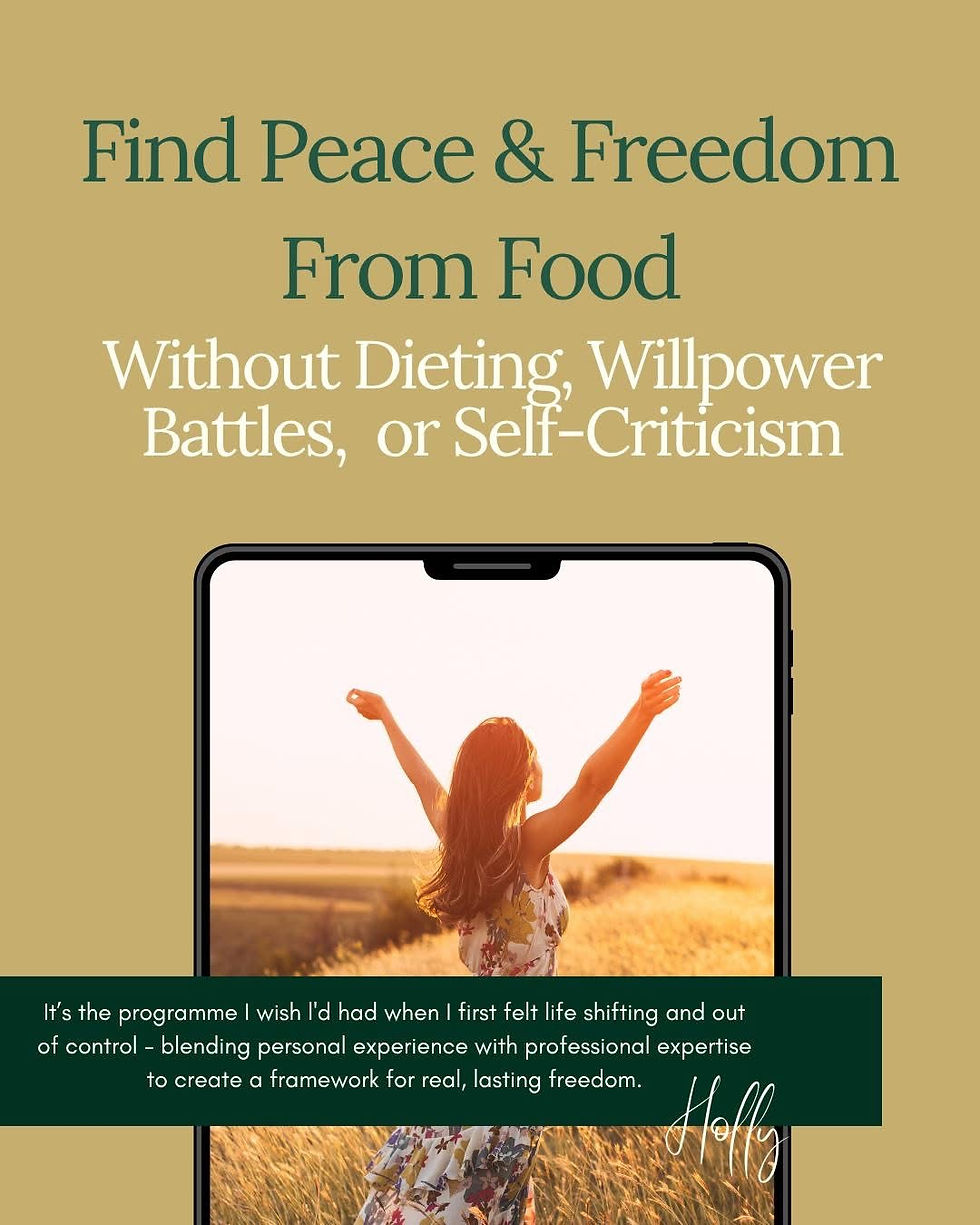
This is exactly why I created the PEACE Programme™.
Rather than another weight-loss programme or restrictive meal plan, PEACE helps women understand what's happening inside both the brain and body.
Together we focus on:
P – Pause & Reset
Calming the nervous system so decisions come from your wise brain rather than your survival brain.
E – Eat with Ease
Learning to nourish your body without guilt, rules or constant food anxiety.
A – Awareness & Acceptance
Building confidence, self-trust and compassion instead of self-criticism.
C – Calm & Clarity
Reducing stress, improving sleep and supporting emotional resilience.
E – Empowered Action
Creating sustainable habits that support long-term wellbeing rather than short-term dieting.
Why Solution Focused Hypnotherapy Works
As a Solution Focused Clinical Hypnotherapist, I don't spend months analysing everything that's gone wrong.
Instead, we help your brain become better at creating what's possible.
Through Solution Focused Hypnotherapy we work to:
reduce anxiety
regulate the nervous system
strengthen motivation
reduce emotional eating
calm food obsession
rebuild confidence
support lasting behavioural change
When the brain feels calmer and safer, healthy choices become easier—not because you're forcing yourself, but because your brain is working with you instead of against you.
Recovery Is Possible
Whether you're experiencing emotional eating, chronic dieting, binge eating, body image concerns or simply feel exhausted by constantly thinking about food, it is never too late to change your relationship with eating.
Menopause doesn't have to be the beginning of a battle with your body.
It can become the beginning of a healthier, kinder relationship with yourself.
One built on nourishment.
Not punishment.
On peace.
Not perfection.

Ready to Find Peace With Food?
If you're tired of dieting, obsessing about food or feeling like you've lost trust in your own body, I'd love to help.
My PEACE Programme™ combines Solution Focused Hypnotherapy, neuroscience, nutrition education and compassionate coaching to help women create lasting freedom with food during menopause and beyond.
You don't need another diet.
You need a different approach.



Comments